Is AI training actually mandatory for my company?
Yes. Article 4 of the EU AI Act has been directly applicable across the EU since 2 February 2025. It applies to every company whose staff uses AI systems - including everyday tools like ChatGPT or Copilot - with no company-size threshold. The obligation is to ensure documented, role-appropriate AI literacy for your people.
What happens on 2 August 2026?
On 2 August 2026, AESIA - Spain's AI supervision agency - acquires full powers to inspect companies, demand evidence of AI literacy, and impose sanctions. The obligation already exists; from that date it is actively enforced. Companies that can show a training plan, attendance records, and an AI-systems inventory are the ones prepared for an inspection.
Is there an official AI Act certification?
No. Per the European Commission's November 2025 FAQ, no official certification exists or is required. The law works on proportionality: what counts is documented, role-proportional training plus evidence - an inventory of AI systems, a training plan, attendance records, and periodic review. Be cautious of providers who sell an 'official certificate'; it does not exist. We give you the four-document evidence pack that actually matters.
What about the content-labeling obligation on 2 December 2026?
Article 50 of the AI Act requires clear labeling of AI-generated or AI-manipulated (synthetic) content, and that deadline has been moved up to 2 December 2026. If your company produces marketing, media, or e-commerce content with AI, our marketing module covers exactly what you must label and how to document it.
How long is the training and what is the format?
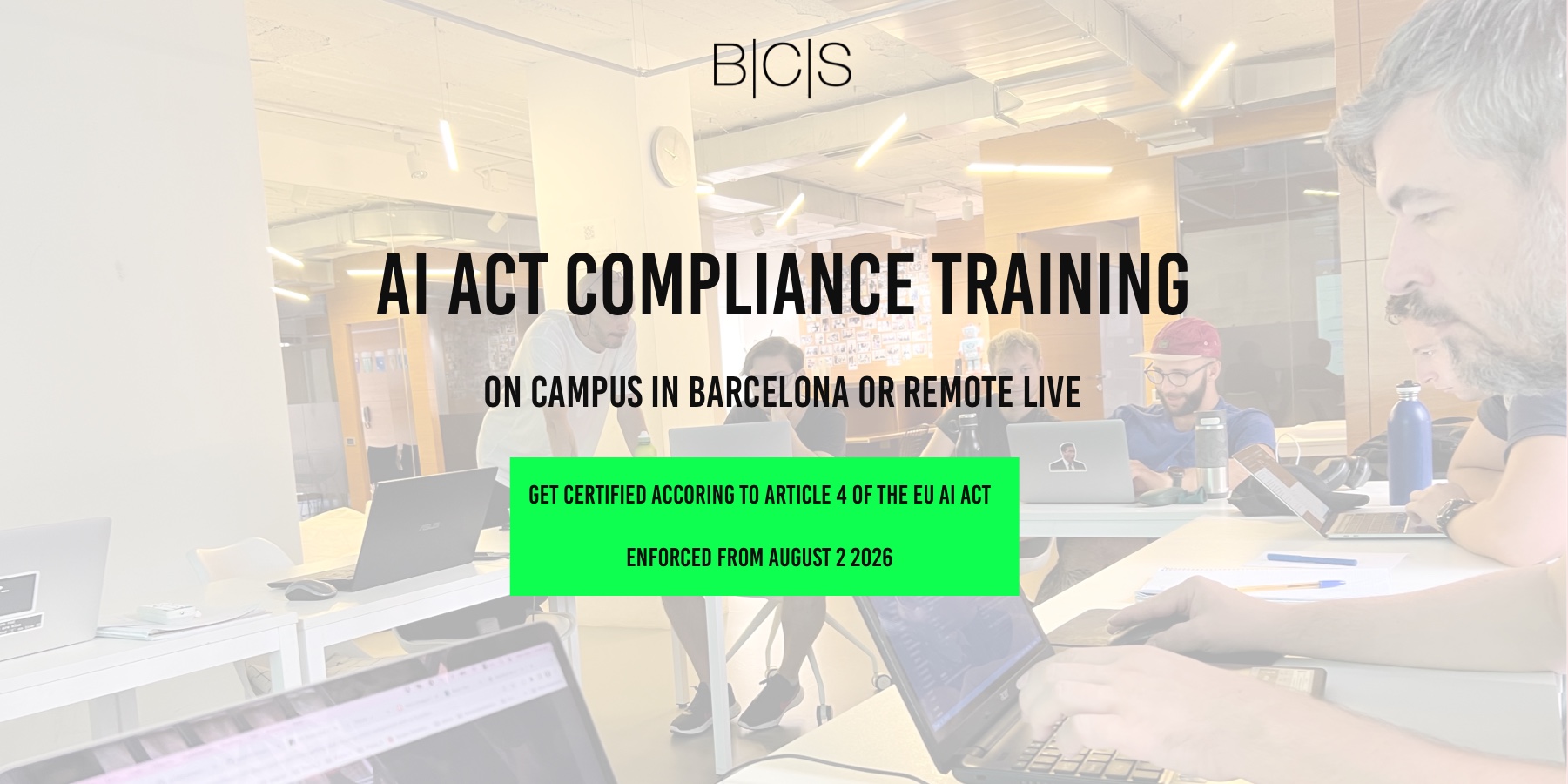
The open compliance cohort is 4 hours: one 4-hour session on campus in Barcelona (or remote live) or two 2-hour sessions. The in-company pack is also 4 hours, delivered at your offices or remote live, and can be scheduled to fit your team's availability.
Who should attend?
Anyone on your team who uses AI tools in their work - management, operations, marketing, HR, finance, customer service. The training is role-proportional: leadership gets the governance and risk view, staff get the safe-use and documentation practices for their day-to-day tools.
What do we walk away with?
Every participant is trained, and every client company receives the four-document Article 4 evidence pack: a certificate and attendance record, an AI usage policy template, and an AI-systems inventory - the documentation an inspection actually asks for.
What language is the training in?
We deliver in English or Spanish depending on your team. Materials and the evidence pack are provided in Spanish and English.
Do you provide legal opinions?
No - and you should be wary of trainers who do. We deliver hands-on, technical AI-literacy training and the compliance documentation. For formal legal opinions we partner with a specialist law firm and can refer you.
Can you train several small companies together?
Yes. Open cohorts mix participants from many companies (up to 15 per group).